Asbestos Safety Information
for the World Trade Center
New York City
by Paul Safchuck
Question (questions by Cyndi
Norman): There are new cases of people getting exposed to the dust.
Most of these have past but there may be more buildings coming down and
anyone walking through the area will get the dust on their shoes, clothes,
etc. Rescue workers are at greatest risk. The authorities are rinsing
people with hoses and saying to launder dusty clothes separately, but
I don't think that's enough, do you?
The destruction of the WTC buildings, particularly the Twin Towers has
caused a great release of various toxins. It is unfortunate that those
who are our heroes in the rescue and the innocent bystanders are being
exposed to asbestos.
Over five thousand tons of asbestos were used in just insulation for
the structural steel. The tragic attack on these buildings has rendered
much of this to environmental dust. One only has to look at how NYC responded
to the exploded gas or steam lines to see how difficult this problem will
be for years to come. It is sad that lack of proper protection for the
heroes and their support personnel and supporters has allowed the terrorists
to plant miniature bombs in the lungs of thousands, if not millions, of
those in New York City.
Spraying individuals off with fire hoses is a crude form of decontamination.
Proper decontamination is relatively simple and quite possible to establish
at Ground Zero. It would consist of tent stations in which the workers
would leave though.
The magnitude of this tragedy makes many of the traditional ways of
controlling asbestos dust impossible to use. However, public information,
which would warn bystanders and promote personal protection amongst workers,
is still an option. It is an option that should be utilized.
Question: What should you do if you've already tracked the dust throughout
your home, car, work, etc?
Asbestos contamination of a home is very difficult to clean up. Under
most conditions this job should be done by a company licensed to handle
asbestos. If the home owner is unsure about the contamination and wants
to take precautions for removing suspected dust, they may wish to follow
these guidelines:
- Asbestos contaminated dust must be taken up wet, such as wet cloth.
- The cloth must be disposed of in a sealed bag.
- Do not use normal vacuums on this dust. Asbestos fibers are too thin
to be trapped by normal vacuum filtration.
- The filtration which captures most of the asbestos fibers is known
as High Efficiency Particulate Air Filter or HEPA. This filtration removes
99.97% of the fibers whose widths are .25 microns or greater.
If rugs, carpets and clothing are contaminated it is many times easier
to bag them up and dispose of them. Automobiles and homes can be cleaned
professionally by licensed professionals.
Question: How can you protect yourself if you live in the area--can
asbestos be in the air?
Asbestos is most certainly in the air, to what amount is yet to be known.
The farther you are from Ground Zero and the farther you are away from
the wind currents going through Ground Zero, the better. Air conditioners
should be set to recycle air rather than bring in fresh air. All dust
should be wet wiped up where possible. You should not go to Ground Zero
or close to it without respiratory protection, full body cover and disposable
booties.
Question: What do you think about the advice for residents to close
their windows and run the air conditioning? I read in another article
that air conditioning ducts pull in asbestos and distribute them throughout
a building.
See above, definitely keep windows closed if possible.
Question: How should you protect yourself if you are walking or driving
through an affected area?
Unless you have full body protection and a respirator which is approved
for asbestos use by the National Institute of Occupational Safety and
Health (stamped on the unit NIOSH approved) do not go into this area.
Until this area is thoroughly cleaned no one should go there unless they
have a reason which is equal in weight to the elevated life time risk
of cancer.
Question: How can protect yourself if you are a rescue worker (or other
person) spending time around the WTC crash site. How can you not expose
your family?
Do not bring your work clothes home, do not wear your work clothes in
your car, do not work without full personal protection which includes
respirator, body covering, and gloves. Leave all work-related clothing,
tools, etc outside the home. Do not wash your contaminated clothing in
your home. Discard it if possible in sealed plastic bags.
Question: What do you think of the statement that people at the WTC
site don't have to worry because asbestos-based illness is the result
of years of exposure, not a single one? I agree it's more likely the longer
you are there, but isn't one small exposure enough for some people? And
if you are covered with dust, head to toe, in the eyes, in the lungs,
isn't that the equivalent of years of low to moderate level exposures?
The amount of exposure has not been measured to my knowledge. I would
recommend that all rescue workers request air sampling where the samples
are read with a Transmission Electron Microscope. I would also recommend
that all workers retrieve one half 35 mm film canister of sample dust.
This should be labeled and sent to a lab (pick from those in the phone
book that advertise for asbestos analysis) with request for either Polarized
Light Microscopy or Transmission Electron Microscope. The former is least
expensive and is generally sufficient for most bulk samples.
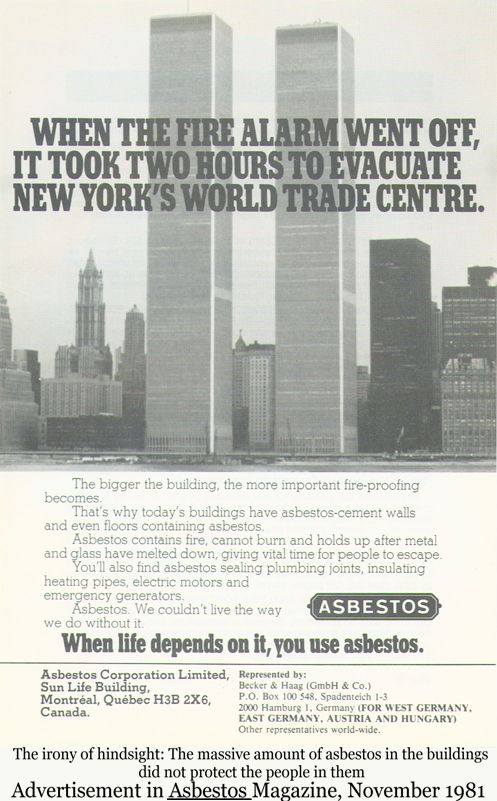
Asbestos
Magazine Advertisement, November 1981
For more information on toxins releases as a result of the World Trade
Center fires and collapse, please go to September
11, 2001: The Toxic Aftermath.
|
4/16/05: Spectre to Introduce
U.S. Asbestos Bill This Week
5/22/05: Individuals Injured
by Asbestos Exposure Oppose Specter's Trust Fund Legislation
10/16/05: Victim's Organizations
Form Asbestos Victims Coalition in Opposition to Asbestos Trust
Fund Legislation
11/17/05: White Lung Mourns Jose
Jesus Pessora
12/18/05: Frist Introducing Asbestos
Bill in January
12/04/06: Asbestos Watch Newsletter:
Help Celebrate the 27th Anniversary of the WHITE LUNG ASSOCIATION
|
Asbestos Victim's Superfund
Compensation Program
Asbestos Watch March 14, 2005 (Maryland
chapter of the White Lung Association meetings)
Directorate of Safety, Health,
and Environment (open letter)
(more...)
|
|
Joe Oliver's Alerts:
Joe Oliver, National Board Member and former President of the
White Lung Association, has issued a call to all persons to help
gather evidence on the conspiracy by asbestos trade organizations
to suppress the knowledge about the hazards of asbestos exposure. If you know anything about this horrific history or have documents
which can be used to further prove their heinous crimes, please
contact Joe Oliver, WLA, POB 1483, Balt. MD 21203.
|
The White Lung Association stands
in opposition to The Specter Bill (S.852)
|
|
|
S.1115: Bill to amend the Toxic Substances
Control Act to reduce the health risks posed by asbestos-containing
products - This bill is supported by the WLA.
Meet Mr. Asbestos
Proceedings of the Asbestos
Symposium for the Asian Countries - now available for purchase.
Australia Bans
Asbestos!
(more...)
|
Senator Specter Breaks Promise to
Mesothelioma Patient and Research Community
Senate Judiciary Committee returns to
Mark-Up on May 11th: Proposed asbestos trust fund legislation
will further penalize victims of asbestos-caused diseases
(more...)
|
|
|
In
May 2003, the Global Environment & Technology Foundation developed
the "Asbestos Strategies" report.
|
The latest issue is Spring 2005
(more...)
|
|
The latest issue is January 4, 2007
(more...)
|
Features:
December 17, 2000 is Asbestos Hazard Awareness Day
(more...)
|
Current Projects:
Asbestos Museum
|
Articles & Publications:
Occupational Respiratory Diseases:
Asbestos Associated Disease -- Reprinted from: Maxcy-Rosenau
Public Health and Preventative Medicine 11th ed. (John
M. Last, Ed.) 1980, Appleton-Century-Crofts
Asbestos Victims Deserve Compensation
Not Betrayal: position release by the Board of Directors, White
Lung Association
(more...)
|
|
|
|
In Memoria:
Paul Safchuck May
21, 2003
Dr. William
Nicholson Dies at 70
Ray Sentes Brave
Fighter For Asbestos Victims
|
|